Mr. Mosgorovsky
The Seven Dials MysteryMr. Mosgorovsky, the Russian proprietor of the Seven Dials Club, is a central figure in the novel’s reversal of appearances: the bearded man who seems to direct a threatening secret society is in fact Superintendent Battle’s lieutenant and a valuable British anti-Bolshevist agent. His club, his careful arrangements, and his authority over the society’s meetings make him look like the hidden criminal power Bundle Brent fears; the final explanation recasts those same features as part of a covert intelligence operation.
Identity and Public Position
Bundle first learns about Mosgorovsky from Alfred, the former servant who admits that he left Chimneys after being paid to do so. Alfred describes Mosgorovsky as the gentleman who runs the club, a Russian, and a notably clever man. His account also ties Mosgorovsky to the practical arrangements surrounding the change of servants: he knew a young man ready to take Alfred’s place, and Alfred’s departure was settled through the household’s usual channel. Bundle recognizes that this matches her suspicions about how someone had entered Chimneys, although the evidence does not make Mosgorovsky himself the person who infiltrated the house.
The club’s organization strengthens his public authority. It has been raided twice, Alfred tells Bundle, but nothing compromising was found because of the neatness of Mosgorovsky’s arrangements. That detail initially suggests an operator skilled at protecting an illicit establishment. Later, Battle supplies a different context: Mosgorovsky runs the club and a host of other things, and his work for the British cause makes his ability to maintain arrangements and keep information controlled an asset. The novel lets the same competence support suspicion before it supports explanation.
The Secret Meetings
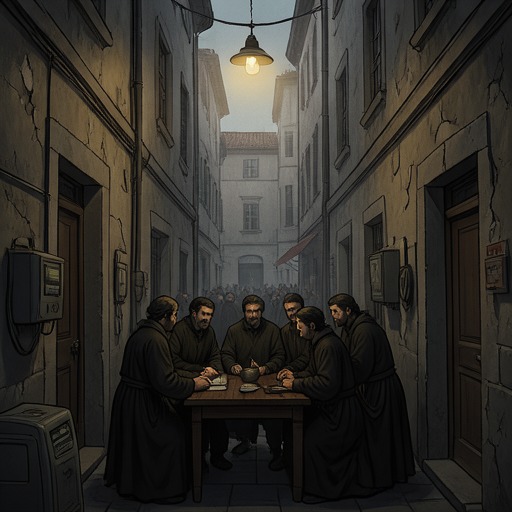
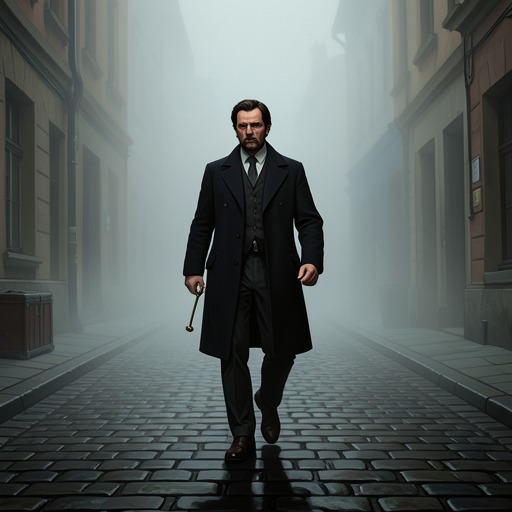
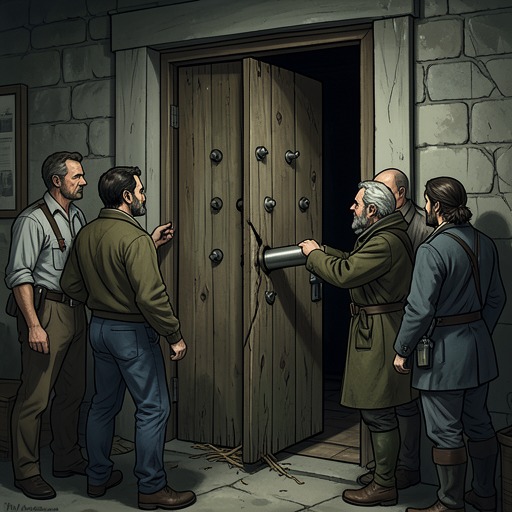
Bundle sees Mosgorovsky before she knows the full purpose of the organization. Watching from concealment, she recognizes him as the broad-shouldered, powerful-looking man with a long black beard whom she had noticed at a baccarat table. He stands beside a table, stroking his beard, and later takes his place at the head of the meeting. When seven taps sound, he goes to the secret door; once the participants are assembled, he asks whether proceedings should begin. His position, the hidden chamber, and the masked attendees make the gathering look like the council of a criminal organization.
At the meeting, Mosgorovsky gives voice to the society’s sense of danger. He says that too much is becoming known about the group and its location, that several people are suspicious, and that those people must be silenced. Bundle, hidden nearby, understands this as a threat that could apply to her if she is discovered. His words are therefore consequential even before the novel reveals the group’s real purpose: from her restricted viewpoint, his authority and the threat of violence appear to confirm the most alarming interpretation.
He also directs discussion of the events that have drawn Bundle to the club. He asks about the letter Gerald Wade left, learns that Lady Eileen Brent found it and that it was written to Gerald’s sister, and calls the situation unfortunate. He then turns to the inquest on Ronald Devereux, asking whether it has been arranged for, while another member reports that stories about local boys practising with rifles have been spread. He closes the business by wishing the woman assigned a dangerous part good luck. In isolation, these remarks seem to connect him to the concealment of murders and the planning of further crime. The later disclosure changes their meaning: he is managing a covert operation whose members face real danger, while Bundle has not yet been told who is working for whom.
Bundle and the Revelation
Mosgorovsky’s first direct encounters with Bundle occur under conditions that preserve the uncertainty. When she investigates the club, she asks Alfred who Mosgorovsky is, but Alfred can provide only the public identity of its Russian proprietor. Later, when Superintendent Battle appears in disguise as a footman at Chimneys, Bundle is startled by the discovery. The contrast between her amateur investigations and the police operation around her helps explain why Mosgorovsky’s role remains hidden: even the apparent shape of the organization has been designed to mislead anyone who sees only part of it.
Near the end, Mosgorovsky enters the room where Bundle and Bill Eversleigh are together. Bill steps in front of Bundle and asks to speak with him privately. Mosgorovsky pauses, strokes his beard, and then says that Bundle will come with him. The exchange can still be read as coercive; Bill assures her that she will be safe, but Bundle does not know what he has planned. Mosgorovsky subsequently addresses her formally and leads her downstairs to an emergency meeting of the Seven Dials Society. The masked figures are again seated around the table, but this time No. 7 occupies the chair at its head. The return to the chamber that Bundle had earlier watched from hiding turns her former position as an unseen observer into a direct confrontation with the organization’s concealed structure.
Battle explains that Mosgorovsky has been his lieutenant and has been in the know all along, while most other members have followed his orders blindly. He identifies him as the club’s proprietor and as Britain’s most valuable Secret Anti-Bolshevist Agent. This is the decisive correction to Bundle’s assumptions: Mosgorovsky’s apparent command of the society is real, but the society is not simply a criminal conspiracy under a hidden master. Its secrecy and dramatic trappings have obscured a government-linked effort.
Methods and Narrative Significance
Battle traces the organization to Gerald Wade, who proposed that a group of young people undertake secret-service work. Battle warned Wade that it could be dangerous and required recruits to understand the risk. Mosgorovsky’s place in this arrangement shows how the amateurs’ enthusiasm depended on a more experienced operative who could manage the club, coordinate activity, and give orders. The members’ lack of complete knowledge is also part of the operation: they could act under Mosgorovsky’s direction without all understanding the larger purpose, a division of information that appears sinister to an outsider such as Bundle.
The contrast between Mosgorovsky’s first appearance and Battle’s final explanation is central to the character’s effect. The story introduces him through Bundle’s limited sightline: a black-bearded proprietor in a secret room, presiding over masked figures and speaking of people who must be silenced. Later, the same room becomes the setting for his identification as an agent serving the country. The reversal does not erase the danger of the work; Battle emphasizes that the group has faced serious risks. Instead, it shows how the novel makes the visual language of conspiracy—hidden doors, masks, numbered places, and an authoritative leader—ambiguous. Mosgorovsky is both the club’s commanding public figure and a covert operative, and the gap between those roles sustains the mystery until Battle supplies the missing context.